%20-%20Teams%20Logo.png?width=576&height=182&name=Logo%20in%20standard%20arrangement%202%20(RGB)%20-%20Teams%20Logo.png "Epic Fusion")

«We pay for the tool, so the result belongs to us.» Neither of those statements is true, says Kerstin Bäcker, referring to one of the biggest misconceptions surrounding AI and copyright law.
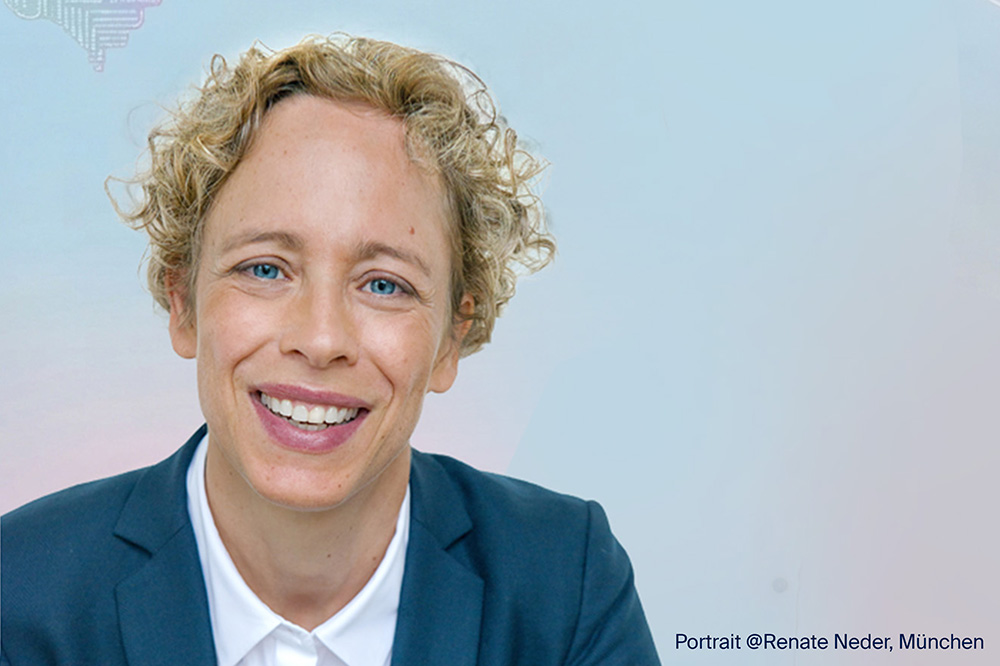
Kerstin Bäcker is an AI expert, a lawyer specializing in copyright law, and a partner at LAUSEN. In this interview, she discusses the legal risks of AI-generated content, common misconceptions about copyright law, and how companies can use AI creatively and responsibly – without any unpleasant surprises upon publication.

Kerstin, you are a tech lawyer specializing in copyright law. How did you actually get into this field?
I originally come from the media sector, and I have always found it fascinating, at the intersection with technology, to see how new technical and economic developments can be adapted to an existing legal framework – and where, if necessary, adjustments may be needed.
Today, AI creates images, text, videos, and music in seconds. Where do you think we stand: in the midst of a creative revolution or flying blind legally?
Neither, because the use of AI to generate images and text does not involve creativity as an inherently human trait as long as humans do not take control of the AI’s output. From the perspective of AI providers, it is also not a massive legal leap in the dark, since – from the perspective of rights holders – the greatest theft of intellectual property in human history occurs when AI providers use protected content for AI training and output without permission or compensation. Rather, the goal is to find a fair balance between the uses by AI providers and the rights holders and to give rights holders back control. From the users’ perspective, this is not a legal leap in the dark either, since users have options when selecting tools and can use them responsibly.
Everyone is talking about speed and efficiency with AI. Hardly anyone talks about liability. Why has not this issue made its way to the executive suite at most companies yet?
Because the benefits of AI are immediately apparent, but the risks often do not become clear until months later. For example, in the form of a cease-and-desist letter regarding an image or text that infringes on third-party rights. On top of that, AI tools are often introduced by individual teams, or worse, by individuals as shadow AI. Wthout involving the legal department or executive management. Yet this is clearly a matter for top management: Executive management must ensure clear rules and controls are in place and, in case of doubt, is liable itself if these are lacking.
Who actually owns an image that an AI creates based on my prompt?
It depends on the prompt and the tool used. In principle, an image generated from a prompt is considered «rights-free», meaning no one owns the rights to it. We will explore the key considerations and when the person who wrote the prompt may actually hold rights to the image or text in our webinar on October 22.
Every day, companies publish AI-generated images, text, and videos. If you had to guess, how many of these would be a problem in court?
There are a wide variety of risks here, ranging from plagiarism and false statements to violations of labeling requirements. In any case, there are a number of aspects to consider, but these can be managed in a significantly lower-risk and more responsible manner simply through clear guidelines and employee training.
The EU AI Act, German copyright law, Swiss law: A company publishes content in three countries. Where does the greatest risk lie if one considers only their own legal situation?
The greatest risk lies in assuming that one’s own law is sufficient. Copyright is territorial: the law of the country where content is used or published applies, not the law of the company’s headquarters. In addition, the EU AI Act also applies to Swiss companies as soon as their AI outputs are used in the EU. So anyone publishing AI-generated content in Germany from Switzerland must also keep European transparency and labeling requirements in mind. My advice: Always base your approach on the strictest market.
You are a specialist attorney in copyright law and an AI expert. Which phrase from real-world practice gets on your nerves the most these days: «But the AI does that» or «But everyone does that»?
«But everyone does that.» But that has long been a classic argument for failing to set up processes properly and in compliance with the law. Important: It is not about preventing uses, but about understanding and managing risks.
What is currently one of the biggest misconceptions you hear from companies regarding copyright and AI?
«We pay for the tool, so the result belongs to us and we’re free to use it as we please.» Neither of those statements is true. The license primarily governs the use of the tool, not the rights to the output. Since AI-generated content is usually not protected by copyright, competitors can, in principle, also use it. At the same time, the output can still infringe on third-party rights. For example, if it bears too close a resemblance to existing works, trademarks, or real people. So if you want exclusive content, you will need to contribute creatively yourself and review the results before publication.
A company wants to start using AI in content production tomorrow. What do you recommend?
Make the appropriate tools and versions centrally available. Use AI guidelines (and, if necessary, short training sessions) to raise employee awareness about responsible use. And monitor the use of and experiences with the tool – ideally through an AI coordinator (which could also be a team) – and make adjustments as needed (this is an ongoing process, not a one-time event).
Our webinar «AI for Creativity at the Push of a Button. But who owns the Result?» is coming up soon. What else can we expect from you here?
A speaker who’s passionate about the topic! Using clear, real-world examples, we will explore when an AI-generated result is protected, who owns it, and where the typical pitfalls lie. Most importantly, you will walk away with concrete recommendations that you can implement right away in your own practice. In short: fewer legal provisions, more practical insights, and hopefully some aha-moments. I look forward to seeing you all and answering your questions!
AI for Creativity at the Push of a Button. But who owns the Result?
LAUSEN: Rights for creative ideas and new technologies.